Finding happy songs in popular music has become a game of Battleship. It takes excruciating trial and error before hitting an upbeat tune in a sea of melancholy. I remember when it was the other way around.
Pop music was renowned for pursuing beauty, love, and joy. Hits such as “Happy,” “Love Story,” and “Party in the U.S.A.” echoed positivity, passion, and carefreeness.
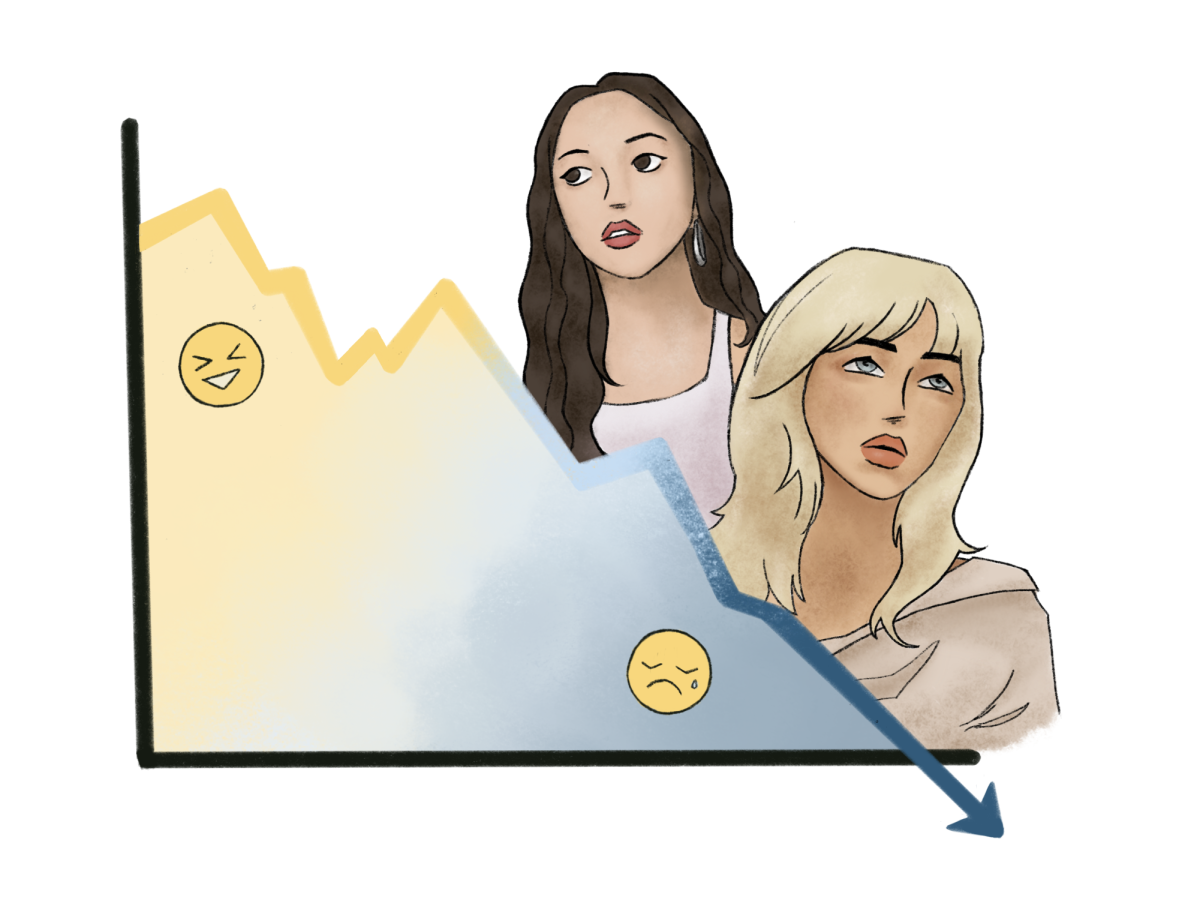
But cheeriness has been fading over the past decade.
Instead of driving with the contagious freedom of “Teenage Dream,” listeners steer through the sorrow of “Driver’s License.” Rather than embracing the motto “Best Day of My Life,” we echo the questions of “What Was I Made For?” Even “happy songs” are secretly sad now, disguising depressing lyrics in upbeat atmospheres: examples include “Blinding Lights” and “Birds of a Feather.”
According to data from Musixmatch over half of the songs on the Billboard Hot 100 express heartbreak in 2025, compared to just a third in 2010. Simultaneously, lyrics charged with despair rose by more than 10 percent.
Pop music reflects listener interest the most. If pop is drifting towards sorrow, does that mean we are all getting sadder?
Yes — and no.
Pop amplifies pain, just like how it used to amplify joy. Pop is not necessarily getting sadder because we are, but rather because we are willing to recognize sorrow more.
The isolating COVID-19 pandemic, widening political divide, and rising social media usage washed away the optimism of the 2010s. Sadness went mainstream because it’s appealing. In a society where resilience is praised and vulnerability is rejected, hearing fragility in a chorus allows us to feel what we struggle to find space for. Sad music is empathetic and nurturing.
Social media plays a critical role because it distributes music at an exponential speed and rewards negative emotion, accelerating the shift in cultural norms. In turn, the industry focuses on the production of melancholic tunes, creating one large, “positive” feedback loop.
Even if pop is getting sadder, I can always listen to “Happy,” but the Spotify algorithm unexpectedly drags me back into a sea of blue. Driven by cultural expectation and algorithmic pull, pop pushes us to what’s acceptable. It’s much harder to survive on the vessels of joy now with the forces actively pulling them under.
I enjoy sad music. Using it to process sadness is healthy, and I appreciate the honesty and rawness melancholic songs bring. However, when sinking into despair is the norm, joy becomes harder to find, which is exactly why we should look for it again.