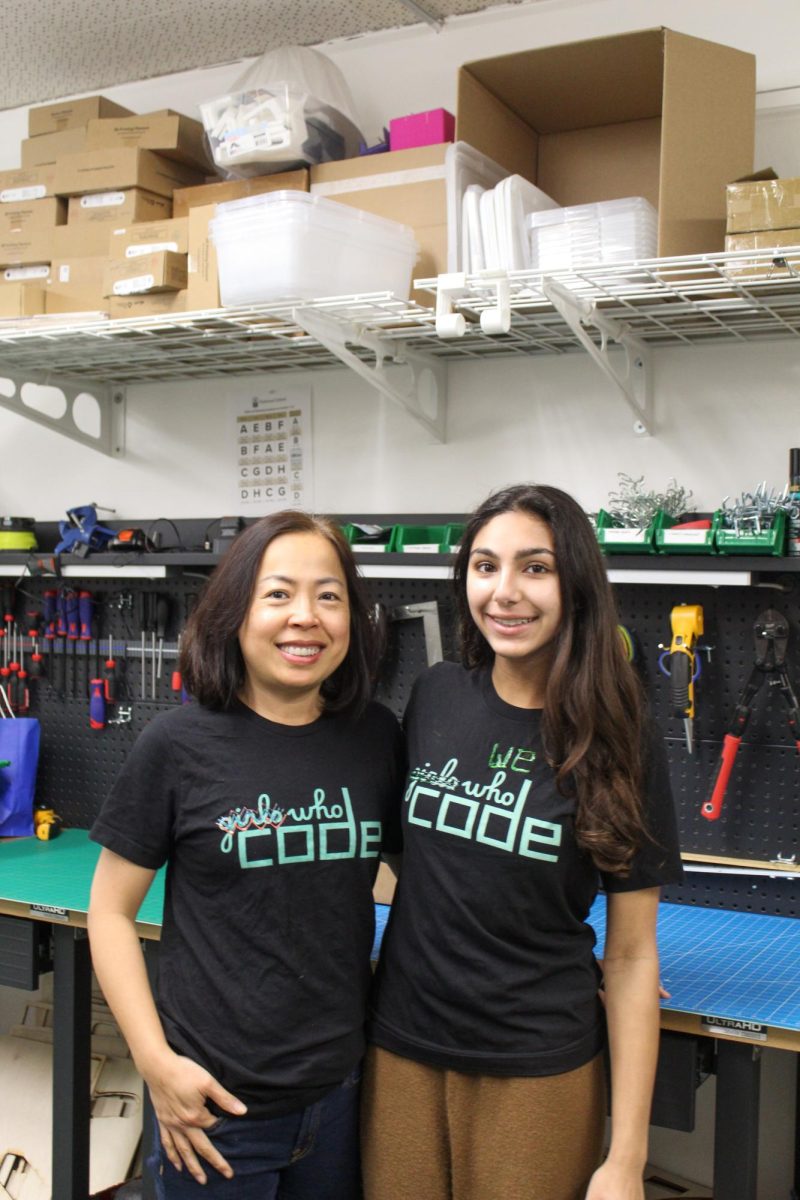
When you think of a coding club, you might picture quiet typing and technical jargon. But Pinewood’s We Who Code was created with something deeper in mind. Originally founded as Girls Who Code, the club aimed to carve out a space where girls felt comfortable stepping into a field that can often feel intimidating.
“We created [the club] so that girls would have a safe space to come and learn coding and basically talk about anything technology related,” Computer Science Department Chair and We Who Code Advisor Christine Tran said.
The club later rebranded to We Who Code to better reflect its expanding community and growth.
“We realized we had other students who wanted to join,” Tran said. “We wanted the name to reflect inclusion while still keeping that safe-space feeling.”
Today, the club brings together all genders, identities, and backgrounds, all united by a shared passion for coding. To support this driven and diverse community, the format of the meetings varies based on what the club is trying to achieve at the time.
“Meetings typically focus on one of four areas: preparing for a competition, hosting a guest speaker, building a collaborative project, or learning a new technical concept,” club president Soha Budhani said.
In recent months, club members prepared for the Presidential AI Challenge, a national competition where students develop AI-powered solutions to solve real world problems. They formed three teams focused on improving traffic systems, addressing teen mental health, and matching unhoused individuals with housing and employment resources.
“Before the deadline, we were brainstorming constantly and building our projects,” Tran said. “After we submitted, we started learning new coding techniques and diving into other tech topics.”
Outside of competitions, the club focuses on mentorship and community service. Recently, the club visited Pinewood’s lower campus to teach second graders coding concepts using “unplugged” activities that enhance algorithmic thinking without computers.
“Teaching little kids isn’t easy,” Tran said. “[Members] had to adjust how they managed the class in real time.”
Beyond technical skills, students gain communication skills from the computer lab that they can apply in other areas of life.
“It became a leadership lesson as much as a coding lesson,” Tran said. “I would say they learn not only technical skills, but also other soft skills.”
Along with topics like programming fundamentals, computational thinking, and an understanding of how AI systems are audited for bias, members develop collaboration, presentation, and problem-solving skills.
We Who Code operates alongside Pinewood’s AP Computer Science Principles course, which has contributed to the school’s recognition for achieving near gender parity in enrollment.
The certification reflects the computer lab’s mission to provide greater access to STEM.
Together, the AP course and We Who Code illustrate Pinewood’s dedication to inclusion in technology, creating a community where every student feels welcome to pull up a chair, open a laptop, and know they belong.