This year, Pinewood has continued to grow its art and design curriculum with Digital Fabrication and Production. The class takes an interdisciplinary approach to design and teaches students the process of taking an idea and bringing it to life using software such as Blender and Tinkercad.
“It’s really just as much about the concept and the idea as it is about the finished product,” Digital Fabrication teacher Sasha Vu said.
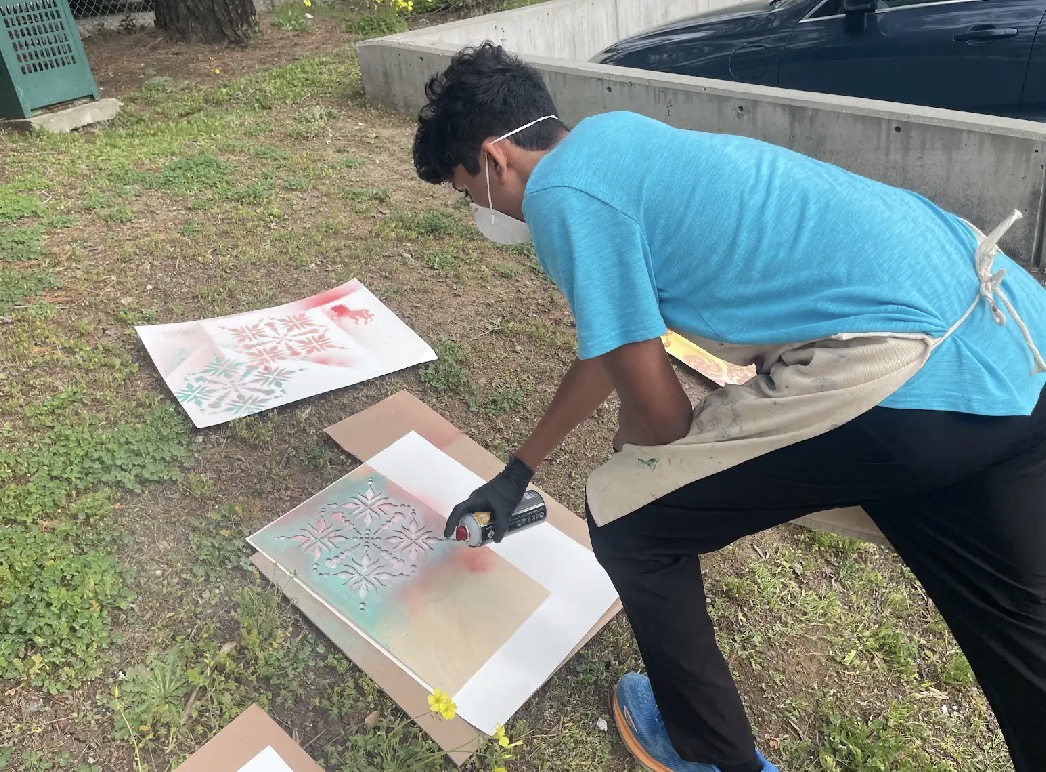
Students participate in a variety of hands-on projects that explore various techniques, with a focus on laser cutting and 3D printing. Some examples of projects completed so far include a pendant design and creating stencils to spray-paint a T-shirt. Their next project will be to design a board game from scratch.
“We [are creating] all of our own molds and 3D printing the box and everything,” freshman Darsh Dwarak said.
When selecting class projects, Vu sets the general direction but provides students with the freedom to design what they want.
“It really is about giving students the nudge, the idea, [and] the structure,” Vu said. “But [also] having the free range with their creativity and allowing them to kind of play with the concepts that they feel passionate about.”
This flexibility is one of Dwarark’s favorite aspects of the class.
“I like how we can create our own thing using the CAD software,” Dwarak said. “We bring an image to life, and then we have it in a tangible product. I just enjoy that creativity and engineering.”
Vu believes what sets Digital Fabrication apart from other art classes, such as Graphic Design, is the incorporation of fabrication technologies.
“It’s a different class in the sense that it’s so much more about the creation of an object and about harnessing these specific digital fabrication technologies to make finished products,” Vu said. “I would say it’s a cousin to graphic design.”
Vu also believes that the skills learned in Digital Fabrication are highly applicable to the real world.
“As far as 3D printing things like medical supplies [and] specific hardware, I think 3D printing can fill a lot of gaps of things that would be more expensive,” Vu said.
As part of the hardware team for Pinewood robotics, Dwarak applies these newly acquired skills when assembling the robot.
“Many components of the robot and its prototypes come from 3D models and lasercut wood,” Dwarak said. “In Digital Fabrication and Production, we learn software to CAD these prototypes and pieces to add to our robot.”
Given the wide applications of these design technologies, such as in robotics, Vu hopes to find ways for the class to contribute to the Pinewood community.
“It’s a great idea to [think about] how we can identify… school-wide problems that there could be a solution for in something that we make,” Vu said.
Ultimately, Digital Fabrication and Production is not just teaching students how to design with new tools, but how to use these technologies to make a meaningful impact.