
The following article is the opinion of the writer and does not reflect the views of The Perennial or Pinewood School. We invite civil discourse about this topic and encourage those with dissenting opinions to reach out to our staff at [email protected].
In December, China organized military blockade drills around Taiwan, firing more than two dozen rockets and practicing port seizures. These activities were part of the most recent escalation of a warning China has been giving not just Taiwan, but the entire world, for decades: Taiwan is not permitted to seek independence, and other countries are not allowed to help Taiwan nor interfere in China-Taiwan affairs.
China’s opposition to Taiwan’s independence isn’t new, and neither is the waxing and waning hostility and political tension between the two. At the end of the Chinese Civil War in 1949, the Chinese Nationalist Party retreated to Taiwan, leaving the Chinese Communist Party in control of China. Since then, the separate political regimes backing the island and mainland have disputed land ownership for more than 70 years. The Taiwan Strait, the small stretch of Pacific Ocean in between the two territories, has become one of the tensest political areas in the world and has borne host to multiple Strait Crises in the past. In fact, beginning in 1958, Taiwan and China fired nonlethal shells across the Strait every day for 21 years, reminding each other of the threat on the other side.
What began as contention over which political party truly represents China has since evolved into a different argument. Taiwan lost its seat in the United Nations in 1971 when the UN recognized the People’s Republic of China as China’s legitimate government. Slowly, newer generations in Taiwan began to desire Taiwan’s independence instead of reinstation as China’s government.
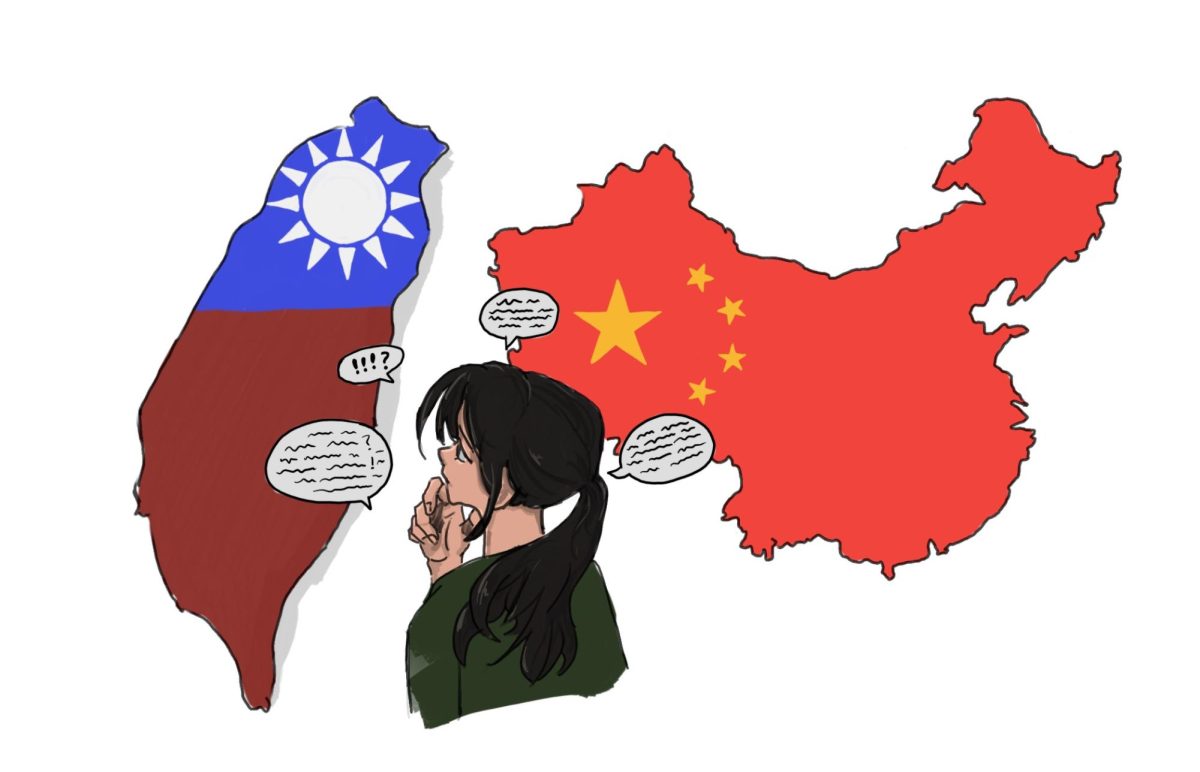
I grew up listening to my parents ask the same questions over and over again. If Taiwan has its own name, why is it tactically substituted with titles like “Chinese Taipei”? If Taiwan has its own flag, why aren’t Taiwanese athletes allowed to raise it at the Olympics? If Taiwan has its own passport, government, military, language, currency –– if Taiwan functions like its own country, why can’t it be recognized as such?
Perhaps because of my parents’ laments, I’ve always identified myself as strictly Taiwanese, always clearly separated my ethnicity from China. But the truth is, 95%-97% of Taiwan’s population is Han Chinese, the same ethnic group as 91% of China’s population. Three out of four of my grandparents immigrated to Taiwan directly from China during the Chinese Civil War, making my ancestral ties to China much closer to me than I originally thought. While my parents hope for Taiwan’s independence, my grandmother prays for China to reunify Taiwan so she can return to the country she still considers her home.
Although Taiwan and China maintain close ties in business and heritage, culturally, the two have long diverged as a result of decades of separation, Japanese colonization of Taiwan, and the communist Cultural Revolution Taiwan never experienced. Taiwan is not China. Not anymore.
Today, Taiwan stays submerged in political strife, something China encourages in order to keep reunification open as a plausible option that Taiwan might consider. Tensions across the Strait have spiked again as a result of the December military drills. Relations between China and the United States depend somewhat on how much support and recognition the U.S. gives Taiwan. Internally, Taiwan’s president, Lai Ching-te, is facing potential impeachment.
On the other hand, Taiwan became the first Asian country to legalize same-sex marriage in 2019. Its economy is the 21st largest in the world. It is home to the only Michelin-starred ice cream in the world. Alex Honnold, the world’s most famous free solo climber, just completed his 1.5-hour summit of Taipei 101. Taiwan is appearing in the news more frequently for better things, things that aren’t related to politics or China. Even without being officially recognized as a country by the majority of the world, Taiwan continues to grow and flourish amidst ongoing political tensions, further distinguishing itself as an autonomous state with every news article and global acknowledgement.
I’m proud of where my parents came from and the great accomplishments our little country has achieved in less than a century. No matter whether Taiwan attains independence, reunifies with China, or maintains its geopolitical status quo, I’ll continue to identify myself as Taiwanese to acknowledge the distinct culture and people that I belong to.
Sources:
- https://www.youtube.com/watch?v=x-XdOaZPhBw&t=1229s
- https://news.usni.org/2025/12/30/chinese-forces-fire-rockets-near-taiwan-practice-port-seizure-amphibious-forces
- https://www.hks.harvard.edu/faculty-research/policy-topics/international-relations-security/understanding-relationship-between
- https://www.taipeitimes.com/News/feat/archives/2016/12/04/2003660529
- https://focustaiwan.tw/politics/202601210011