
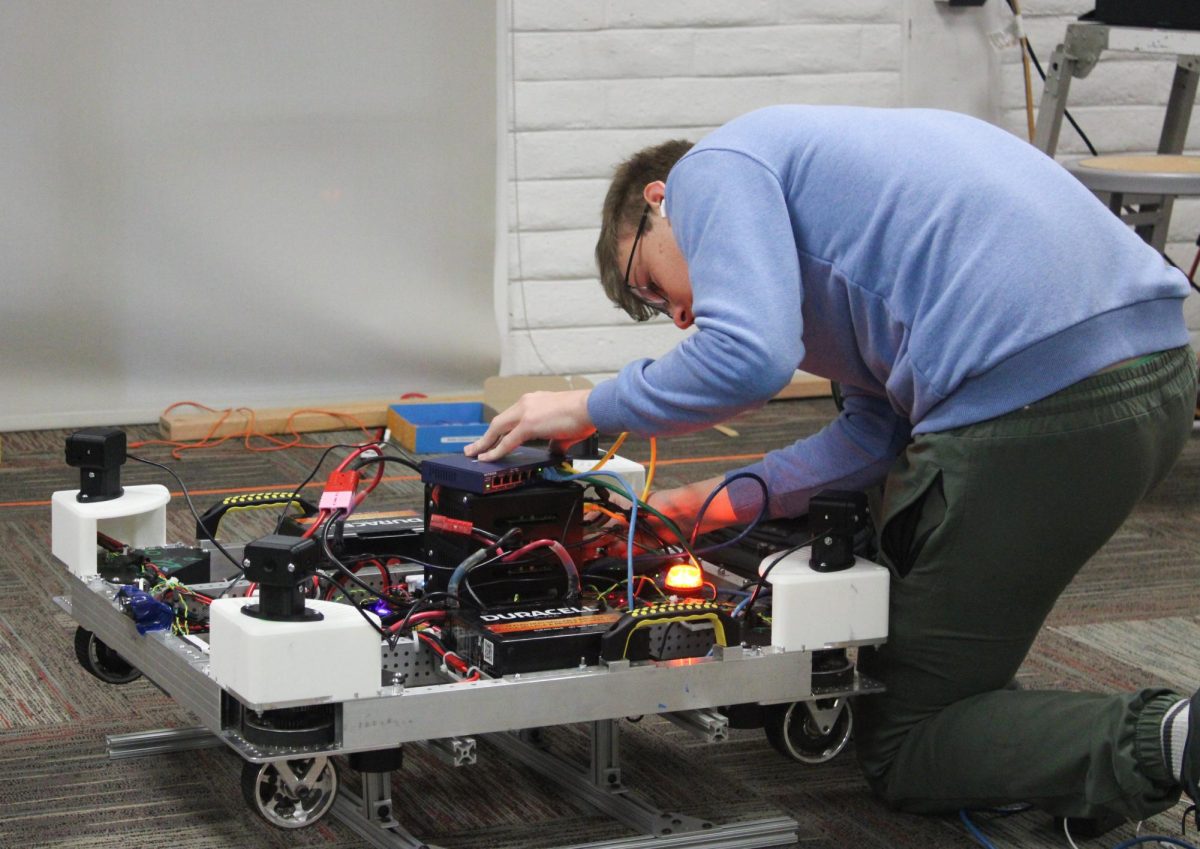
Every January, high schools across the world launch teams to compete in the FIRST (For Inspiration and Recognition of Science and Technology) Robotics Competition, one of the most demanding robotics and engineering competitions.
Each year, the competition announces a new game, and this time, it involves propelling small balls into a net.
“It’s a little like a basketball game,” freshman robotics team member Arudran Prabhakaran said. “The scoring system, lines, and rules essentially require each team to build a three-point shooter from various ranges.”
Robots can only collect and shoot the balls during their designated scoring period while simultaneously attempting to climb a ladder at the end of the match to gain extra points. Additionally, the match includes a new 15-second free-for-all period, which adds another layer of strategy.
The Pinewood team this year hopes to focus on bringing precision, speed, and coordination into one machine. They only have eight to nine weeks to build their fully functioning robot.
So far, the team has already designed prototypes capable of completing half of the tasks in the game. Most notably, members are currently developing an intake system using spinning wheels to collect and shoot the balls with more precision. Prabhakaran said the team has increased its workload.
“Before, you’d come in twice a week,” Prabhakaran said. “Now, people are here every day ready to get to work.”
As team members’ schedules get busier during competition season, Pinewood’s team must make do with fewer members. Senior Jayanth Ananth said that this is one of Pinewood’s areas of weakness.
“I think our biggest constraint is manpower and time because Pinewood is such a small school and people have extracurricular activities,”
Ananth said.
Leadership plays a crucial role in the process as well, with veteran seniors mentoring the new freshmen on board. Coach Will Rees appreciates the varying roles seniors play.
“Seniors inspire mostly by being role models,” Rees said. “They take robotics seriously, and that attitude gives new members a sense of the atmosphere [and] a sense of what’s expected.”
In the end, the team’s success depends on every member contributing their unique skills and effort toward a shared goal.
“No matter how small the task seems, every person plays a role in making the robot function,” Ananth said. “When everyone does their part, that’s when the team really comes together.”


