
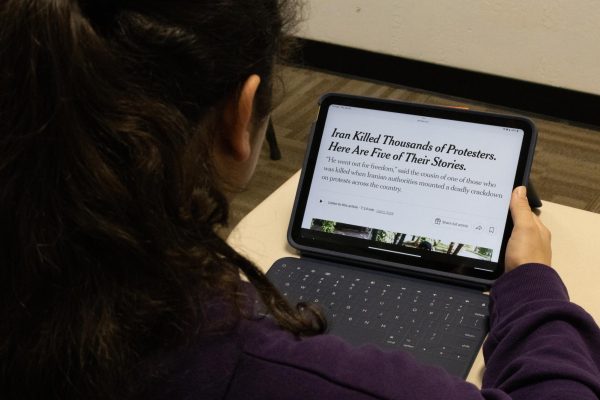
The beginning of 2026 saw the rise of new conflicts and the intensification of existing ones. We talked with members of the Pinewood community about the effects of some of these issues.
Venezuela
In January, the United States military invaded Venezuela and detained the country’s president, Nicolás Maduro.
The operation, launched by United States President Donald Trump without congressional approval, has raised questions as to whether it violated international law and Venezuela’s sovereignty.
Senior Jack Hollenbeck, a leader of Pinewood’s Model UN club, was shocked by the raid and believes that there was not enough international acknowledgement of the operation.
“I don’t feel like the global reaction has been commensurate with what happened,” Hollenbeck said.
Hollenbeck said he is concerned about the nature of the attack.
“[Maduro] is a leader who hurts his people, and intervention is justified, but the method in which it was done wasn’t the right way to go about it,” Hollenbeck said. “There should be more focus on working with [Venezuela] versus antagonizing it and creating a vacuum that could create more crime.”
Sudan
The Sudanese Civil War, which began in April, 2023, centers around a struggle for control of the country. All attempts at peace talks have been unsuccessful, and an ever-growing humanitarian crisis continues to spread through Sudan.
Hollenbeck and junior Rishi Chen, the leader of Pinewood’s student advocacy group, SAFE, said that international action is necessary to end the war. Hollenbeck said he hopes that the United Nations
will step in.
“Intervening in this conflict will cost lives, but it’s going to create a safer place,” Hollenbeck said.
Chen said that without foreign recognition, it is unlikely that the country will see peace soon.
“It’ll take someone big who’s actually looking to broker something and to put the conflict on the map a little bit more,” Chen said. “As of right now, there’s no voice for Sudan, at least on a global level.”
Iran
According to the New York Times, protests began in Iran in December after the value of Iran’s currency, the rial, fell to a record low.
The demonstrations have since evolved, with protestors now demanding women’s rights and an end to the Islamic Republic of Iran’s rule.
In an attempt to quell the dissent, the Iranian government has killed thousands of protesters and instituted widespread internet blackouts since the beginning of January.
Freshman Leila Saeidi said that international media coverage of images of Iran during times of peace
has been impactful.
“There are a lot of Persian people sharing their videos of the beautiful, peaceful Iran and reminding the public that Iran isn’t just a country with this horrible reputation,” Saeidi said.
Senior Zaiden Saberi said that global coverage of the protests may prompt support from the country’s international allies.
“The more attention it gets, the better the outcome will be,” Saberi said. “Other countries disregard Iran, and it can get kind of lost, but I think Iran’s at a point where it needs [outside] help.”
Saeidi said that the protesters are completely devoted to their cause.
“It’s just people who want freedom, really,” Saeidi said. “[The protesters are] people who say that this is our country, we want it to be beautiful, and we need freedom to be a right.”


